
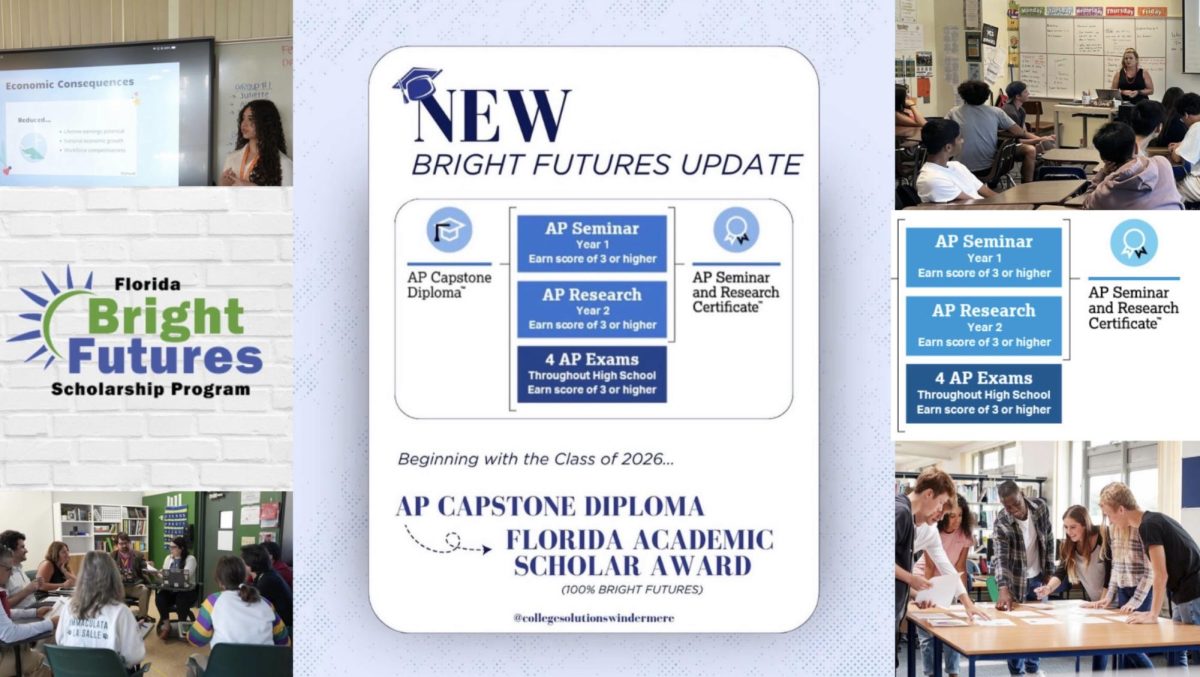
Recent updates to Florida’s scholarship pathways have made AP Seminar an even more valuable course for high school students. Now, students who successfully complete AP Seminar and its second course, AP Research, as part of the AP Capstone program, can qualify for the highest level of the Bright Futures Scholarship which covers 100% of tuition at eligible public colleges in Florida.
AP Capstone is a two-year diploma program offered by the College Board that consists of AP Seminar followed by AP Research. In AP Seminar, students learn to analyze issues, evaluate sources, and develop evidence-based arguments. AP Research builds on these skills by requiring students to design, conduct, and present an original research project. Together, these courses emphasize independent thinking, academic writing, and real-world problem solving skills.
“Despite how difficult and challenging enrolling in the AP Capstone program can be at times, I know that my hard work will eventually pay off in the future. And like they say, sometimes you really do have to put up with the storm to find the rainbow,” said sophomore Sophia Saud.
The Bright Futures Scholarship is a merit-based program funded by the state of Florida that helps students pay for college tuition. To earn 100% coverage, known as the Florida Academic Scholars (FAS) level, students must meet several requirements. These include maintaining a high GPA (typically around 3.5 or higher), earning a qualifying SAT or ACT score, completing a required number of community service or work hours, and graduating from a Florida high school. By completing AP Capstone, students can strengthen their academic profile and use this coursework to help meet or enhance eligibility requirements for full Bright Futures funding.
“Taking AP Seminar makes me feel more confident about my future because I know I’m building the skills I need to actually earn Bright Futures and pay for college,” said sophomore Emily Rivera-Suazo.
Overall, the connection between AP Seminar and Bright Futures reflects a broader shift toward rewarding students who engage in advanced academic work. For motivated students, this pathway not only builds essential skills; it also opens the door to fully funded higher education opportunities.