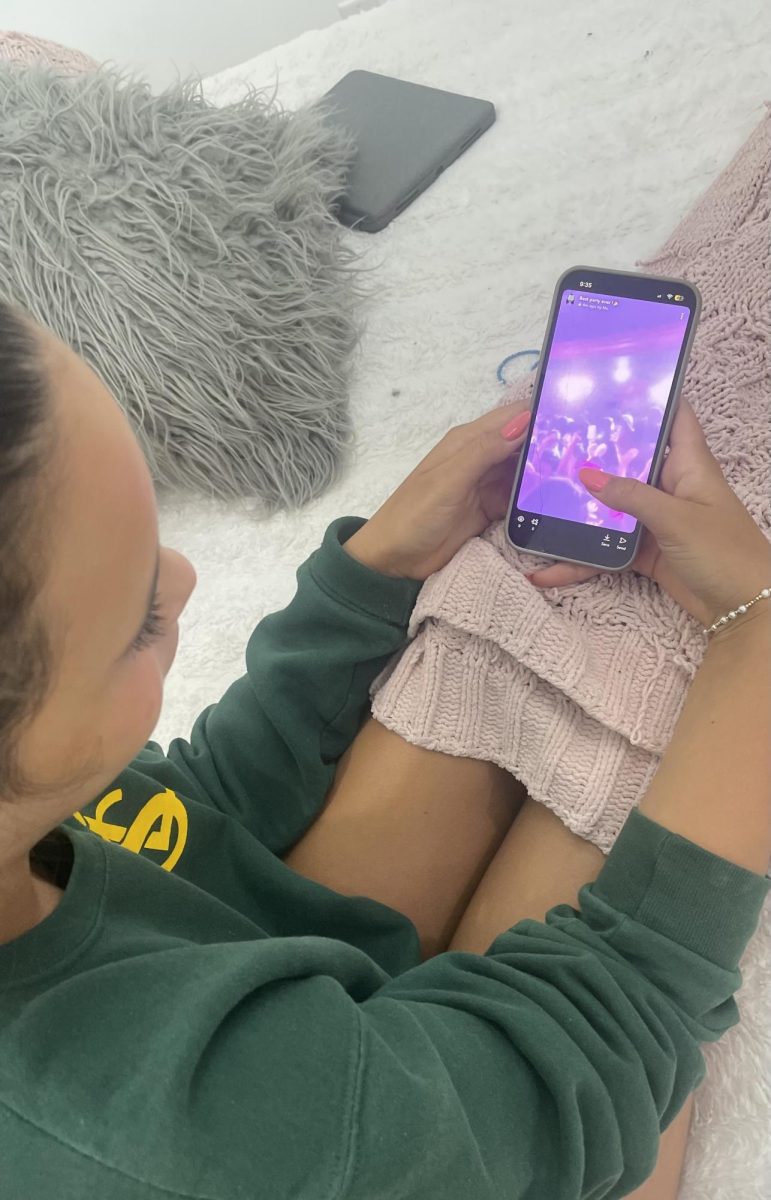
We all know the feeling when there is a party all your friends are at and your parents didn’t let you go. Or a concert for your favorite artist that you couldn’t get tickets for, and you feel awful. You think about how much fun it is, how you’re not there, and how many memories your friends are making without you. It’s probably one of the worst feelings you can experience, especially as a teen. And as we go through life, this is bound to happen time and time again. So why do we experience this feeling so intensely? And how does this relate to social media?
“I hate feeling FOMO. It’s the worst feeling, said freshman Lucia Garcia.
Brain Development
Well, there are different reasons, one being how our brains are wired during this time. During adolescence (the transitional developmental stage between childhood and adulthood), teen brains are hypersensitive to social status. This makes the threat of being left out seem like a life-or-death situation. During this time, your brain’s prefrontal cortex (the part of your brain responsible for logic and long-term perspective) is still maturing. So teens often see things as more dramatic than they actually are.
Biological Drive
Why does being excluded by a group feel so deep? Well, it’s built into our systems. For our very ancient ancestors, being excluded by their tribe wasn’t just some people not liking them; it was practically a death sentence. If they weren’t with a tribe, they could die. Thankfully, it isn’t like that anymore, but our brains still haven’t fully caught onto that. So when you are excluded, your brain is still wired to react like you’re in danger.
Social Pain Felt Same as Physical
This has been shown in many studies, most famously the “Cyberball” study conducted in 2003 by Dr. Naomi Eisenberger and her team at University of California, Los Angeles. Researchers used brain scans to observe brain activity in participants experiencing social exclusion during a virtual game. The study found that this social rejection activated the dorsal anterior cingulate cortex, the same region responsible for processing physical pain. This means that emotional pain is processed in the same part of our brain as physical pain. So when you are left out or experience FOMO, your brain can react as if you are physically hurt.
How Social Media Adds to This
Well, when you see online that you are being excluded, it can trigger the amygdala (our body’s fight-or-flight response), which makes your body see it as a serious threat. Social media also makes this easier because it’s not just happening in person anymore — it’s only a scroll away.
What We Can Do
Well, we can actually do something about this, and there are many ways to help.
Turn Off Things That Trigger Those Emotions
Turn off notifications or mute people’s social media. Or simply avoid social media during those times. You can also schedule breaks when you know you may experience FOMO.
Rewire Your Brain a Bit
When you are panicking, think about what is actually happening. Labeling your emotions can make the situation feel less overwhelming instead of just feeling awful about yourself. Think of it as just one event, not your whole life. (Trust me, it’s hard to think this way, but it helps.) When you see photos online, remember that things are probably not as amazing as they seem. Social media is performative most of the time.
Calm Down
Take a breath. It’s going to be okay. It’s just one event.
In Conclusion
FOMO is something teens and even adults experience, and it’s one of the most human emotions. It comes from our brain’s biological systems and the way we are hardwired to survive. Even though it can feel awful, there are ways to manage it. So the next time you feel those emotions, remember that it’s one of the many things that make us human.
For further research, check out these links: