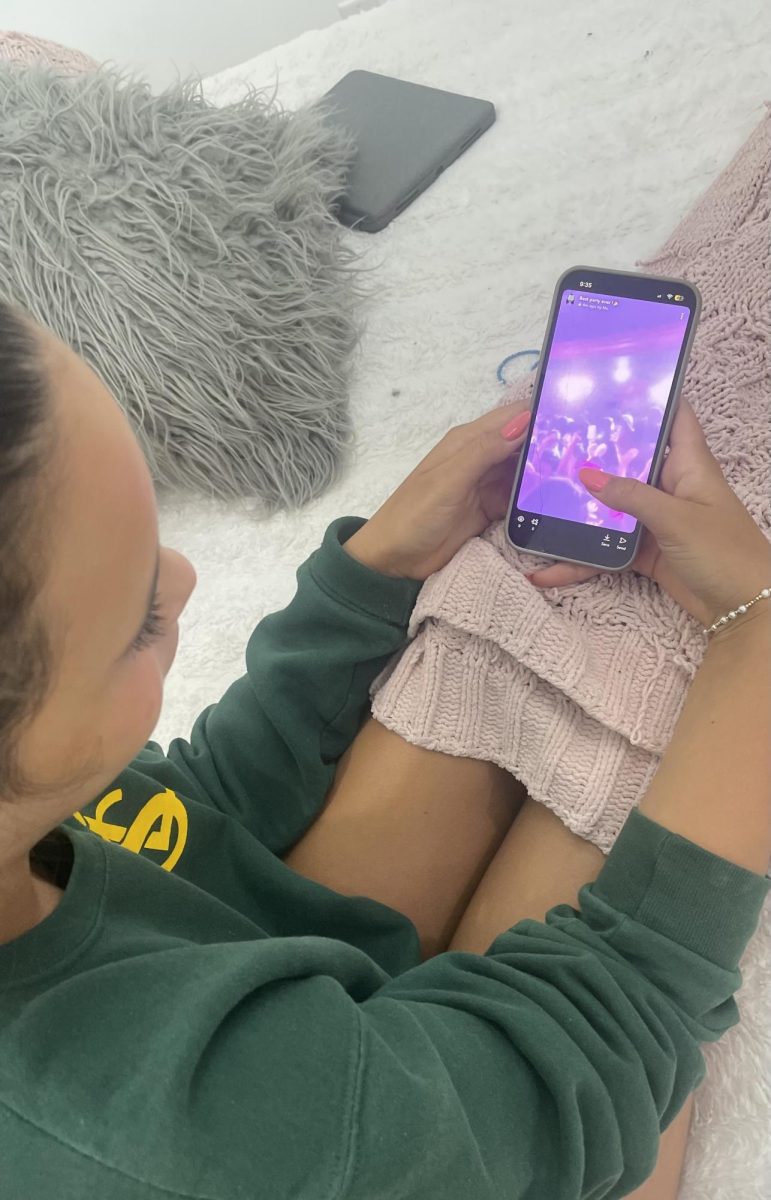
There is an imminent threat to the classic bound book in the form of the radiant rectangle of movie screens, which is changing the neurological approach used by individuals based on different age groups to consume stories.
Whereas Generation X was raised in an environment filled with books and stories as an entertainment media source, Generation Z matured in an age when stories became visually available and instantly accessible to everyone.
“We aren’t only getting tired of books, we are losing our biological patience for listening to one narrator for ten hours straight,” asserts Ms. Isi Saumell, a fourth grade teacher at Emerson Elementary School.
According to the data analyzed by Dr. Raihan El-Naas, (see the link below for further information) time allocated to reading for fun has decreased over the last two decades, especially amongst young Americans.
Americans between 15-24 spent no more than seven minutes reading for fun daily in 2023 (see link below), while spending almost three hours were on leisurely activities involving “screen-based entertainment.”
“I tried reading Anna Karenina, but I found myself thinking why I should not be able to watch the three-hour adaptation on some streaming platform,” admits Angelina Caicedo, a college freshman.

For the members of Generation X, deep reading was something that was built into their education and society prior to the advent of the technological boom.
In particular, this demographic tends to see movies as an addition to the book, while the younger generations tend to look at the book as a slow version of the movie.
“In our case, the book was the HD experience, since imagination had more funding than Hollywood,” observes Ms. Angela Baquedano, a librarian at David Fairchild Elementary.
While movies have certainly affected cognitive abilities negatively, the rise of the visual narrative has created a generation of people who are able to process complicated stories faster than anyone else before.
With the rise of movies, storytelling became a much more socially engaged experience, which now makes reading a solitary activity.
“It’s as if a story does not exist until it’s been analyzed in a video essay or talked about in a Tiktok discussion,” states trend specialist and Florida State University freshman Samantha Lopez.
Surprisingly, whenever a book becomes a blockbuster movie, there is a rush in sales of the book, although studies show that a lot of the “trend-buyers” do not even finish reading their purchase.
The “Netflix Effect” causes a rise in the number of books being owned, although the ability to appreciate the content written in the pages takes a backseat to the aspiration to possess something visually appealing.

“Although I bought the book because of its similar appearance with the movie posters, the absence of a musical score made me dread going through the middle part,” said Cushman School junior Sophie Chacha, referring to the play, Romeo and Juliet and the modern adaptation, & Juliet, both of which she saw on the stage. Even though plays, by their structure, are meant to be experienced in person and not necessarily read, the general academic classroom setting often emphasizes the latter.
“Growing up, I loved both the Matilda musical and movie, so imagine my excitement when I came across the book one day. Though wonderfully written, I can’t help but be partial to actually seeing the kids pull off all the tricks and silly things they do. The story just works better when you can visualize it, especially when paired with the upbeat, descriptive musical numbers in the play,” Sophie added.
Education specialists are currently deliberating whether the course syllabus should be redesigned for a “cinematic brain” by including graphic novels and movie scripts.
The idea is to fill the void between the adrenaline rush brought about by contemporary films and the contemplative nature of long-form literary pieces of fiction.
“We cannot deny the fact that the 19th-century novel is struggling against a 21st-century dopamine circuitry system, and right now, the circuitry system is winning,” summarizes freshman FSU business major Mauricio Coronel.
Ultimately, it is not simply a matter of preferring screens to paper, but a shift in the way that the human mind chooses to direct its focus.
For more information on this topic, here is an interesting link:
https://abcnews.com/Health/americans-spend-time-reading-fun-time-screens-study/story?id=124807367