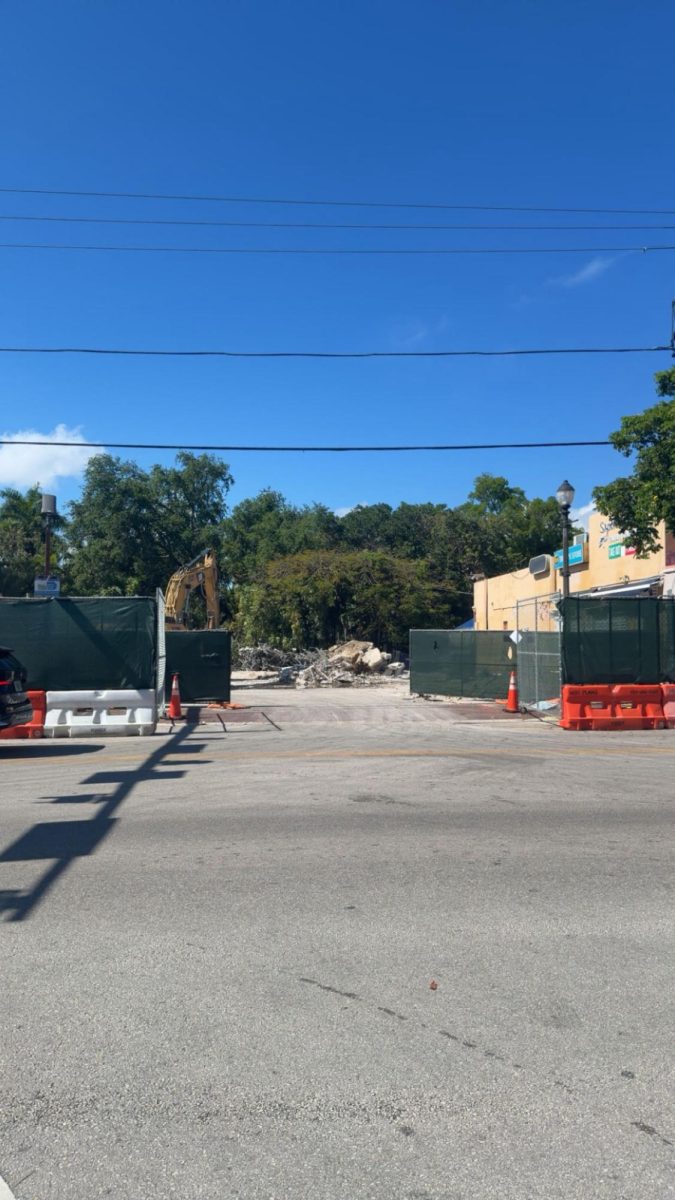
On a recent morning along Grand Avenue in Coconut Grove, the sound of demolition equipment echoed down the street. Behind a temporary fence, piles of broken concrete and twisted metal marked the spot where familiar storefronts had stood only weeks earlier.
For decades, this corner of the Grove was filled with the small routines of everyday life. People stopped for juice after a morning walk, ran into neighbors while doing laundry, or grabbed a quick snack on the way home.
Now, the block is quiet, cleared to make room for a new development that will transform this part of the neighborhood.
Among the businesses recently demolished were The Last Carrot, a beloved vegetarian café that served the community for nearly half a century, Grand 7th Food Store, a small convenience store that locals relied on for everyday essentials, and Coconut Grove Laundry & Cleaners, a laundromat that had quietly served residents since 1961.
For many people in the Grove, these businesses were not famous landmarks. They were something simpler: places that people returned to again and again.
A Block That Was Part of Daily Life
For longtime residents, the businesses along Grand Avenue formed a kind of neighborhood rhythm.
The Last Carrot was known for its fresh juices, smoothies, and vegetarian sandwiches. The restaurant opened in the 1970s, during a time when Coconut Grove was gaining a reputation as a laid-back, artistic community. Over the years, the small café became a favorite gathering place for locals looking for a quick, healthy meal.
Just a few doors away, Grand 7th Food Store offered something different but equally important: convenience. Its shelves carried drinks, snacks, and small grocery items, making it an easy stop for nearby residents who could walk there in minutes. The owner, Firas Hussein, took over the former 7/11 on Grand in the mid-1990s. It bloomed into a cornerstone of the Grove community, and even raised his daughter, Aya Hamza, at the store.

Then there was Coconut Grove Laundry & Cleaners. Opened in 1961, the laundromat served generations of Grove residents. For many people living in older apartment buildings without washers or dryers, it was a weekly destination.
Inside, rows of washing machines hummed while neighbors chatted or waited for their clothes to dry.
“It was the kind of place where you’d run into someone you knew,” said one resident who has lived in Coconut Grove for decades. “You didn’t just go there to do laundry—you’d catch up with people.”
A Street With Deep History
Grand Avenue runs through the heart of the nearby West Grove, a historic neighborhood founded by Bahamian immigrants in the late 1800s.
Many of those early settlers helped build Miami’s first homes, businesses, and roads. Over time, the area developed into a close-knit community where small businesses played a central role in neighborhood life.
For much of the twentieth century, Grand Avenue functioned as a local commercial corridor. Restaurants, shops, barbershops, and service businesses lined the street, serving the families who lived nearby.
The block that recently disappeared was part of that tradition.
A New Vision for the Site
The demolition is part of a major redevelopment project being built by Allen Morris Company, a real estate firm founded in 1958 that has developed projects across the Southeast United States.
The company, led today by chairman and CEO W. Allen Morris, specializes in large mixed-use developments that combine offices, residences, and retail space.
Their Coconut Grove project will transform the 1.7-acre site into a new five-story complex.
Plans include:
- roughly 100,000 square feet of office space
- approximately 40,000 square feet of retail space
- a rooftop restaurant overlooking Biscayne Bay
- about 18 luxury residential units
The project, sometimes called “Ziggurat,” is designed with courtyards and pedestrian walkways intended to connect the development with surrounding streets.
Developers say the project will bring new businesses and economic activity to the area.
A Neighborhood in Transition
Not everyone views the transformation the same way.
In recent years, Coconut Grove has seen a wave of new development. Luxury housing, modern office buildings, and upscale restaurants have appeared across the neighborhood.
Some residents welcome the investment and modernization. Others worry that the rapid changes are slowly erasing the smaller, locally owned businesses that once defined the Grove.
The disappearance of places like The Last Carrot, Grand 7th, and the laundromat has made that change more visible.
What Remains
Today, the site on Grand Avenue looks almost unrecognizable.
Where people once waited for laundry or sat outside with fresh juice, only construction equipment and cleared land remain.
But the memory of those businesses still lingers for many residents.
For decades, they were part of the ordinary moments that make up daily life in a neighborhood: the quick stop for groceries, the casual lunch with friends, the familiar walk down the street.
As a new development begins to rise in their place, the Grove continues to evolve—adding another chapter to the long and complicated story of Coconut Grove.